When a CRM Becomes the Operating System of a Professional Firm
For many professional firms, a CRM begins as a place to store contacts.
Names, email addresses, phone numbers, perhaps a few notes about where a prospect came from.
But when professional services become more complex — involving multiple specialists, documents, payments, deadlines, partners and client interactions — a contact database is no longer enough.
The real opportunity is to turn the CRM into something broader: "the operational infrastructure connecting the client, the coordinating team and the professionals delivering the service".
For the professional firm, this creates structure, visibility and control.
For the client, it creates something equally important: a more coordinated, transparent and consistent experience.
And between those two sides, there is a third layer that increasingly matters: "operational coordination".
This is where IKKA operates.
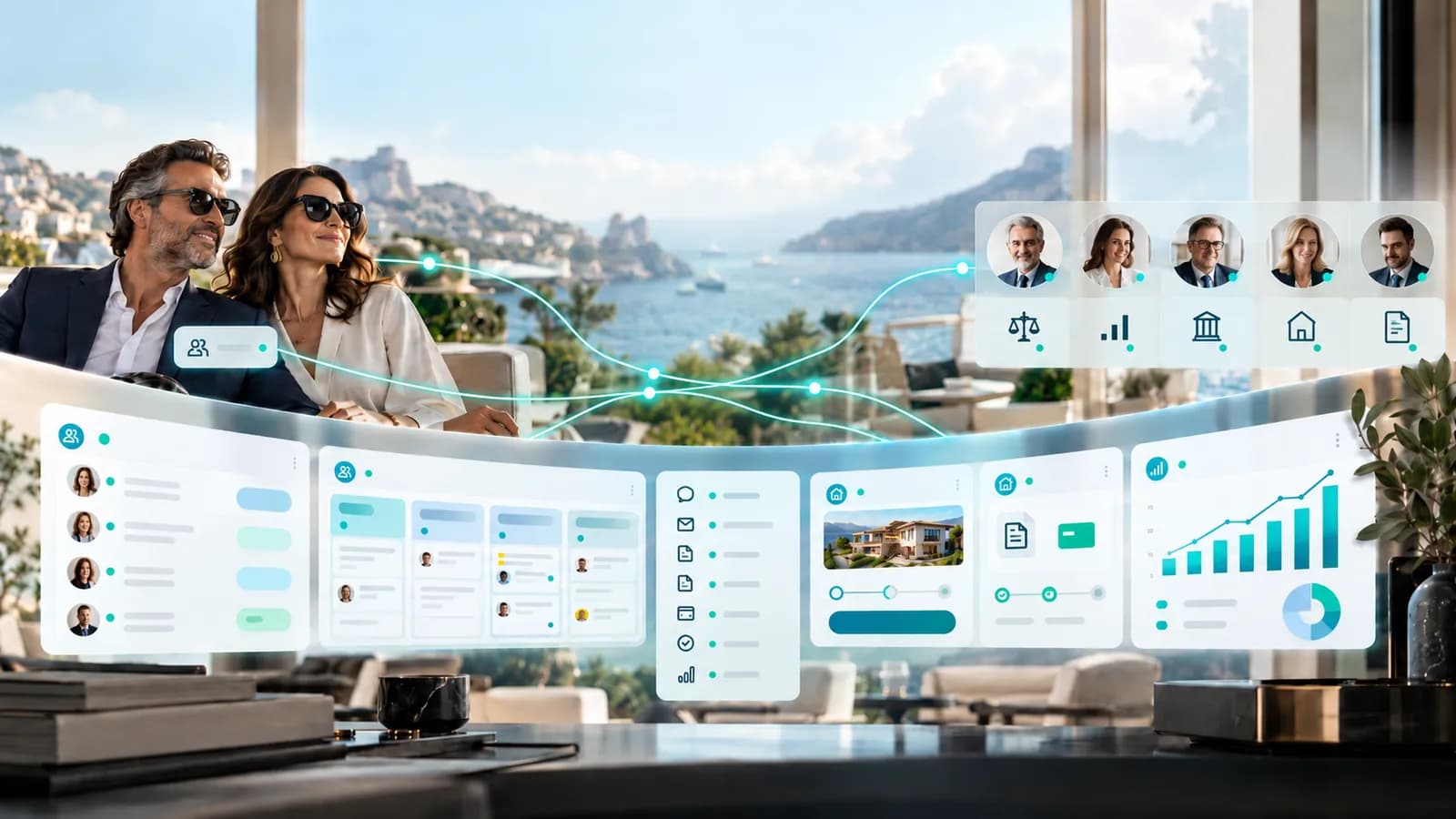
A Premium Service Is Often a Multi-Party Operation
Premium professional services rarely depend on a single person.
A relocation project, investment process, corporate structure, banking arrangement or complex legal matter may involve several independent professionals and service providers.
The client may interact with:
an initial adviser;
an immigration lawyer;
a corporate lawyer;
a bank;
a financial adviser;
a real estate professional;
a CPA;
translators;
administrative personnel;
and other specialized partners.
From the client's perspective, however, these are not ten separate assignments.
They are "one objective".
This creates an important operational challenge.
Each professional may perform their individual function correctly, while the overall client experience still becomes fragmented.
Documents may be requested twice. Updates may come from different people. One provider may be waiting for another without the client understanding why. Payments may be handled separately. Deadlines may exist in individual calendars. And no single participant may have full visibility of the entire project.
For premium services, coordination therefore becomes part of the product itself.
The Client Sees One Journey. The Partners See Many Tasks.
This difference in perspective is fundamental.
A professional partner usually sees the portion of the matter for which they are responsible.
The client sees the entire journey.
For example, a lawyer may focus on an immigration application. A banker may focus on account opening. A real estate adviser may focus on a transaction. A CPA may focus on tax or accounting requirements.
Each activity can have its own internal procedure.
But the client is asking a much simpler question:
“Where are we now, and what happens next?”
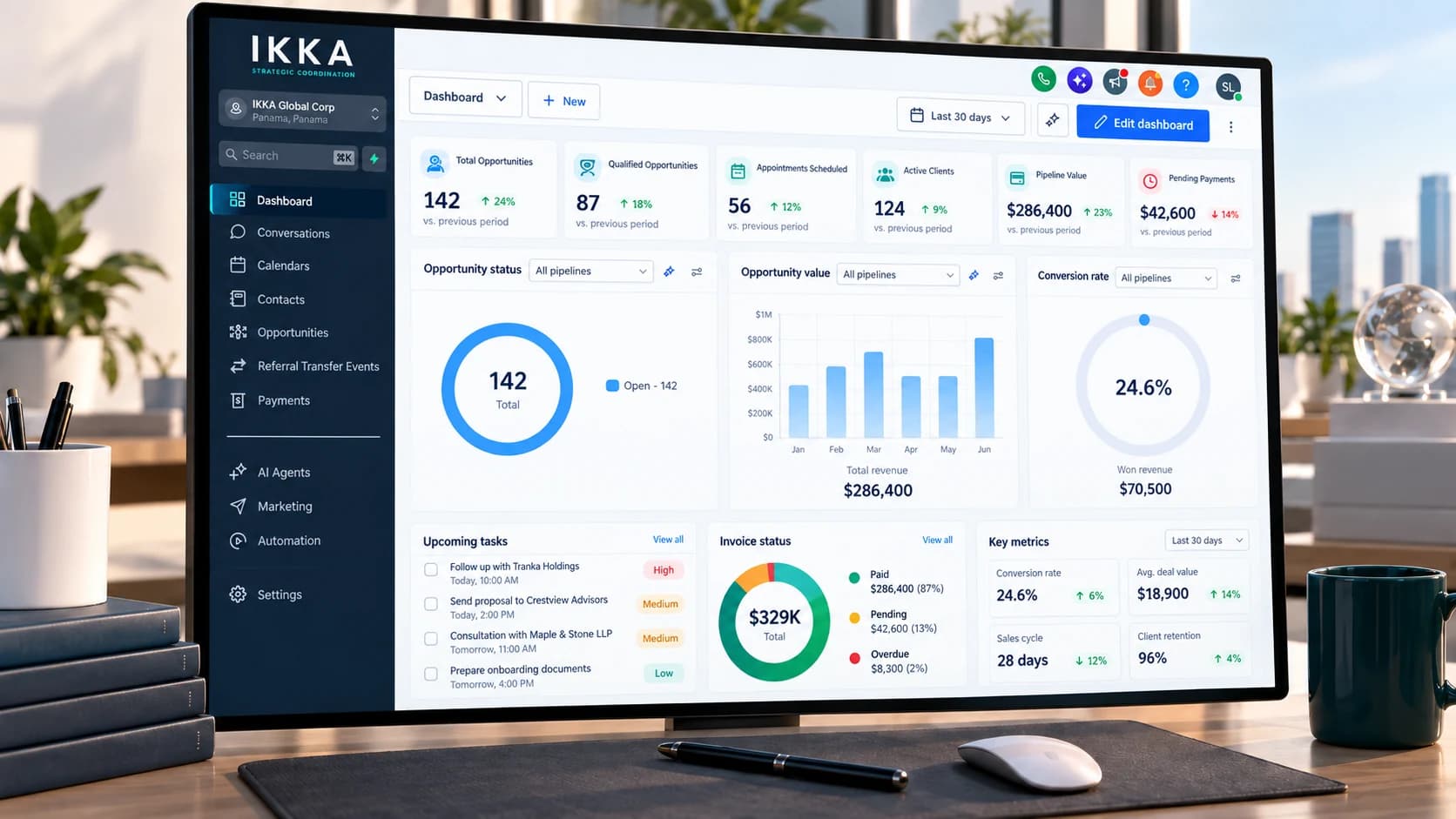
A well-designed CRM can connect these two perspectives. This is the purpose behind IKKA's CRM & Workflow Infrastructure: structuring the operational environment around how the firm and its clients actually work.
It allows each professional to concentrate on their area of expertise while the broader process remains visible and coordinated.
This is particularly important when the client is purchasing a premium package rather than an isolated service.
From CRM to Coordination Infrastructure
Once the system manages more than contacts, its role changes.
It becomes a central operational layer for:
Intake → Qualification → Planning → Professional Assignment → Proposal → Payment → Documentation → Execution → Follow-Up → Reporting
| CRM layer | Primary purpose | What it coordinates |
|---|---|---|
| Intake | Capture the matter | Leads, inquiries and preliminary information |
| Qualification | Understand fit and needs | Client needs, service relevance and routing |
| Planning | Define the roadmap | Scope, professionals, responsibilities and next steps |
| Commercial | Activate the engagement | Proposal, agreement, invoicing and payment |
| Documentation | Organize requirements | Collection, missing items and status |
| Assignment | Connect the right professionals | Specialists, owners and handoffs |
| Execution | Coordinate active work | Operational progress across providers |
| Follow-up | Keep the process moving | Pending actions, reminders and external dependencies |
| Reporting | Create visibility | Client updates and management oversight |
The CRM becomes the environment in which different operational components interact.
It does not replace lawyers, advisers, accountants or other professionals.
It connects their work.
This distinction is important.
Technology should not attempt to automate professional judgment.
Its role is to ensure that professional judgment is supported by accurate information, clear responsibilities and coordinated processes.
Better Intake Benefits Both the Client and the Professional
The quality of a professional engagement often depends on what happens before the first substantive meeting.
Without structured intake, significant time may be spent collecting basic information that could have been organized earlier.
A properly designed intake process can capture relevant details such as those organized through Client Intake & Premium Support:
nationality and residency;
family composition;
corporate structure;
intended investment;
banking requirements;
real estate objectives;
budget parameters;
time constraints;
documents already available;
preferred language;
and services being considered.
For the professional, this means receiving a better-prepared matter.
For the client, it means spending less time repeatedly explaining the same background to different people.
And for the coordinator, it creates the initial map of the project.
One Client Record, Multiple Professionals
One of the biggest advantages of integrated infrastructure is the creation of a structured client record.
Instead of information being scattered across personal WhatsApp conversations, emails, spreadsheets and individual notes, relevant operational information can be connected to the same client journey.
This does not mean every participant should see everything.
Professional confidentiality, permissions and data access remain essential.
Rather, the system should ensure that each authorized participant has access to the information needed for their role.
This creates a fundamental improvement: "the project no longer depends entirely on what individual participants remember".
For professional partners, this reduces administrative friction.
For the client, it reduces repetition and inconsistent communication.
Pipelines Make Complex Services Visible
Professional services are often managed through experience.
An experienced team knows approximately what should happen next.
The problem arises when this knowledge exists mainly in people's heads.
A pipeline transforms that knowledge into an operational structure.
| Operational area | Without a structured pipeline | With a structured pipeline |
|---|---|---|
| Progress | Depends heavily on individual memory | Stages are explicitly defined |
| Responsibility | Ownership may be unclear | Each stage has a responsible owner |
| Pending items | Discovered manually or reactively | Visible within the workflow |
| Follow-up | Depends on individual habits | Can be systematized and monitored |
| Management visibility | Limited view across active matters | The full pipeline can be reviewed |
| Client communication | Updates may be fragmented | Communication follows clear milestones |
A client journey might include stages such as:
New Inquiry → Initial Assessment → Consultation → Strategy Confirmed → Proposal → KYC → Payment → Documentation → Professional Execution → External Processing → Follow-Up → Completion
Other services may require different stages.
The important point is not the specific labels.
It is that everyone involved understands:
where the matter currently stands;
who is responsible;
what is pending;
and what must happen before the next stage begins.
For the partner, this provides clearer case organization.
For the client, it reduces uncertainty.
Communication Should Feel Coordinated
Clients increasingly communicate through several channels.
They may receive a formal proposal by email, ask an urgent question through WhatsApp, upload documents through another platform and speak with a professional through video conference.
The challenge is not supporting multiple communication channels.
The challenge is making them feel like part of the same relationship.
When communications are disconnected, the client experiences the organizational structure behind the service.
They notice when one person does not know what another person has already discussed. They notice when they are asked for the same document twice. They notice when internal handoffs are incomplete.
Premium clients should not need to coordinate the providers themselves.
Digital infrastructure should help the organization coordinate around the client.
Proposals and Payments Should Connect to Execution
A proposal is not merely a commercial document.
It is an operational trigger.
Once a client accepts a service, several things may need to happen:
KYC must be completed;
engagement documents may need signature;
invoices must be issued;
payments verified;
professionals assigned;
documents requested;
internal tasks activated;
and external providers informed.
When these steps depend on manual messages between different people, unnecessary delays appear.
Connecting proposals, invoicing and payments to the operational workflow makes the transition from client acquisition to service delivery much more reliable.
For the professional partner, this means fewer administrative gaps.
For the client, it means that accepting a proposal actually moves the project forward.
Follow-Up Is Part of the Service
Premium service is not only about technical expertise.
It is also about continuity.
Clients remember when they have to chase for updates. They remember when nobody tells them that a third party is causing a delay. They remember when a deadline approaches without warning.
A structured system can create reminders and follow-up mechanisms around:
outstanding documents;
consultations;
proposal decisions;
payments;
external approvals;
banking reviews;
immigration stages;
transaction milestones;
renewals;
and post-service requirements.
Some of these actions can be automated.
Others require a human decision.
The objective is not to automate the relationship.
It is to ensure the relationship does not depend on memory.
Clients Need Visibility Without Operational Noise
There is an important difference between transparency and information overload.
A premium client does not necessarily need to see every internal task.
They need to understand the information that affects them.
For example:
Completed → In Progress → Waiting for Client → Waiting for Professional → Waiting for External Institution → Next Action
| Information layer | Internal operational view | Client-facing view |
|---|---|---|
| Tasks | Multiple tasks, owners and dependencies | Current stage |
| Progress | Detailed internal status across providers | What has been completed |
| Pending items | Provider-specific requirements and blockers | What is waiting |
| Responsibility | Internal ownership and escalation logic | Whether client action is required |
| Workflow | Detailed process rules and dependencies | Next meaningful action |
| History | Full operational record and internal notes | Relevant progress update |
This type of structured visibility can dramatically improve the client experience.
Instead of receiving fragmented updates from different providers, the client can understand the project as a coherent sequence.
This is especially valuable in processes that may last several months.
Partners Benefit From Better-Prepared Clients
Digital infrastructure should not create additional bureaucracy for professional partners.
It should remove it.
If designed correctly, the partner receives:
better-qualified clients;
structured background information;
clearer service scope;
documents organized before professional review;
visibility into outstanding client requirements;
fewer repetitive administrative conversations;
and a clearer record of previous interactions.
This allows professionals to spend more time on the work that actually requires their expertise.
That is one of the most important principles behind IKKA's approach:
Technology should reduce the administrative burden surrounding professional work, not add another layer of administration.
The Client Should Not Become the Project Manager
This is particularly important in multi-service engagements.
Without coordination, clients often become the accidental project managers of their own matters.
They forward emails between professionals. They remind one adviser what another adviser requested. They track deadlines. They ask who needs to be paid next. They explain the same background repeatedly. They attempt to determine which provider is waiting for whom.
For a premium engagement, that is a poor use of the client's time.
The infrastructure should reverse this model.
The professionals should coordinate around the client. Not the other way around.
Reporting Also Improves the Partner Network
Once activity is structured inside a common operational environment, reporting becomes much more useful.
Management can understand:
how many inquiries are entering the system;
which services generate demand;
where clients originate;
which partners are involved;
how long different stages take;
where bottlenecks occur;
which proposals remain pending;
which matters require attention;
which payments are outstanding;
and how the overall client journey is performing.
This information is valuable not only internally.
It can help improve the relationship between coordinators and professional partners.
Patterns become visible. Recurring delays can be identified. Client questions can be anticipated. Documentation requirements can be improved. And successful workflows can be standardized.
Standardization Does Not Mean Treating Every Client the Same
Premium services require flexibility.
Different clients have different priorities, structures, jurisdictions, risk profiles and timelines.
Standardization therefore should not mean forcing every client into an identical process.
It means standardizing the infrastructure around the process.
For example:
how new clients are onboarded;
how responsibilities are assigned;
how documents are requested;
how important events are recorded;
how payments are tracked;
how follow-ups are generated;
and how management obtains visibility.
The professional strategy may remain highly customized.
The operational environment supporting it should be reliable. For organizations that need this continuity on an ongoing basis, Executive Corporate Operations extends the same principle into recurring administrative and multi-provider coordination.
Where IKKA Fits
IKKA's role is not to replace the professional responsible for delivering the underlying service.
Nor is IKKA simply a CRM implementation provider.
IKKA operates between the client experience, professional network and technology infrastructure.
Its role is to design and coordinate the operational environment that allows these components to function together.
Depending on the project, this can include:
designing client intake architecture;
structuring service pipelines;
defining responsibilities and handoffs;
coordinating participating professionals;
configuring CRM workflows;
integrating email and messaging channels;
connecting proposals and payment processes;
organizing follow-up mechanisms;
establishing reporting structures;
coordinating client-facing updates;
and continuously improving workflows as the operation develops.
This creates value on both sides.
For professional partners
IKKA can help provide:
more structured client intake;
clearer scope before handoff;
better organized documentation;
reduced administrative workload;
coordinated communications;
visibility into the broader project;
and a more consistent process for receiving and managing clients.
For premium clients
IKKA can help provide:
a more coherent client journey;
one coordinated operational structure;
fewer repetitive requests;
clearer responsibilities;
better visibility of project progress;
organized communication with multiple professionals;
structured follow-up;
and continuity throughout complex, multi-stage engagements.
IKKA becomes the operational layer connecting these two sides.
The CRM Is Not the Product
There is an important final distinction.
The CRM is not the product.
The workflow is not the product.
The automation is not the product.
The product is the quality of the coordinated professional experience that these systems make possible.
Technology works best when the client barely notices it.
The client simply experiences better organization, clearer communication, fewer delays and greater continuity.
The professional experiences better information, clearer responsibilities, less administrative friction and more time for specialized work.
That is when digital infrastructure has achieved its purpose.
And that is when a CRM becomes more than software.
It becomes part of the operating system connecting the client, the coordinator and the professional network.